Why laser welding needs controlled cooling
Laser welding systems generate concentrated heat very quickly, especially on long runs, thicker sections and repeated spot welds. If the water temperature drifts, the laser source, power supply, optics and ancillary cooling circuits can all run outside their preferred range. That can show up as poor bead consistency, more downtime, alarm trips and in some cases repeat rework.
In Alberton, Germiston and the wider Ekurhuleni industrial area, we often see laser welding systems installed in environments with warm production halls, dust, and summer temperature swings. Add load-shedding, restart surges and high humidity in coastal centres like Durban and Cape Town, and the cooling side becomes a key part of process control. A correctly sized industrial water chiller helps keep the system within spec and gives the operator steadier output across the shift.
Typical laser welding set-up we see on site
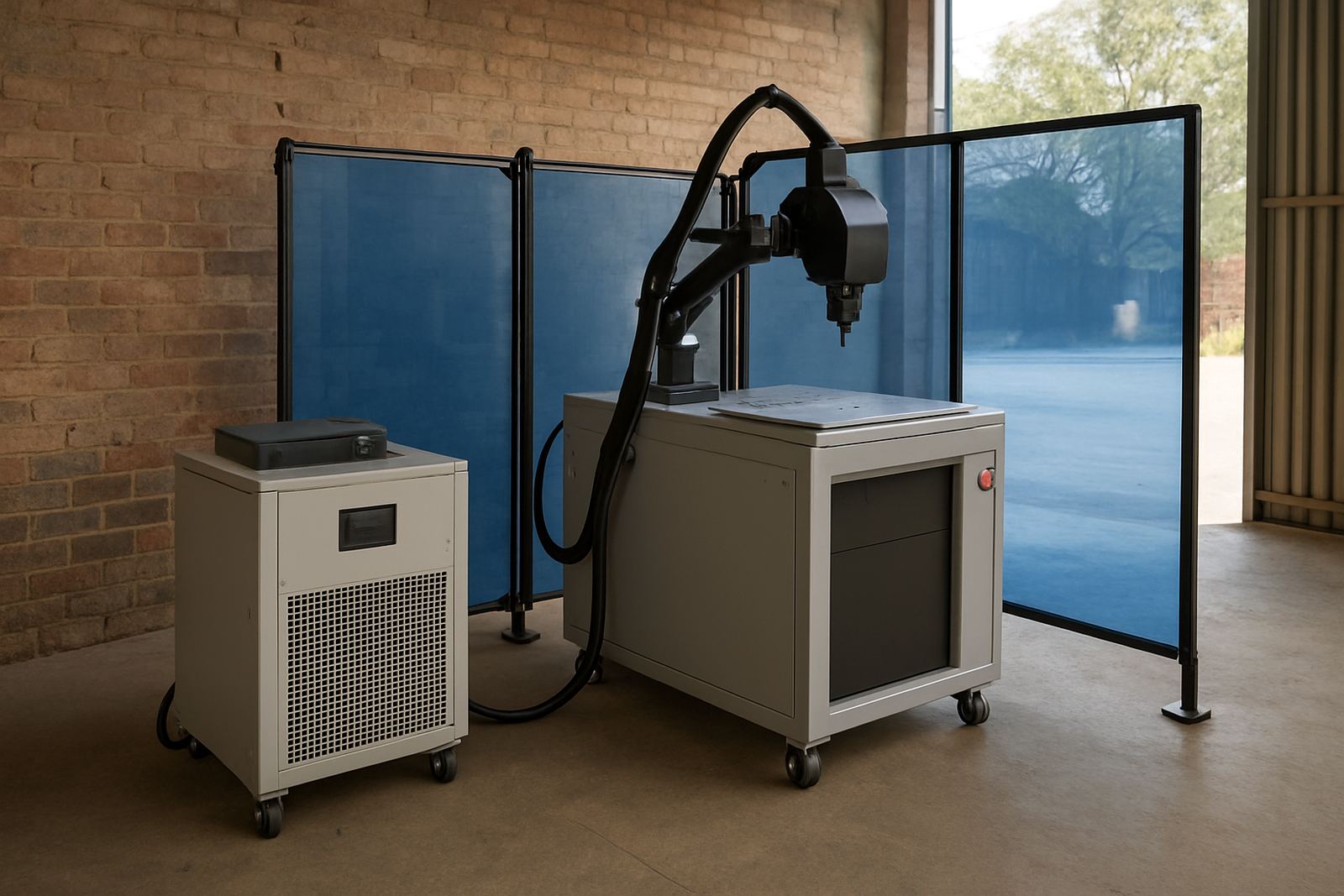
Every site is different, but most laser welding applications need more than just a chiller on the floor. There is usually a laser source, welding head, closed water circuit, pumps, filtration, temperature control and sometimes a separate loop for optics or auxiliary equipment. On larger lines there may also be a plate heat exchanger, buffer tank and monitoring points for flow and return temperature.
- Laser source and power cabinet with dedicated cooling demand
- Welding head or scanner head with tight temperature tolerance
- Closed loop pipework in copper or suitable industrial hose
- Flow switch, pressure gauge and return temperature monitoring
- Filtration and water treatment to reduce scale and corrosion
- Optional backup or temporary cooling during maintenance shutdowns
For many workshops in Johannesburg, Pretoria and Rustenburg, the biggest issue is not the machine itself but the surrounding services. A chiller must fit the actual operating conditions, not only the data sheet. Space, dust, ventilation, ambient temperature and access for maintenance all matter.
How we plan the cooling layout for laser welding lines
A good cooling layout starts with the laser manufacturer's required inlet temperature, flow rate and pressure range. From there we look at the actual production pattern, whether the line runs one shift or three, and whether the machine is used for fine precision parts or heavier fabrication. In some cases a single chiller can serve one unit. In others, it is better to separate the laser source from the process side, especially if the line is long or the load changes during production.
We also check the installation route from the chiller to the laser machine. Shorter pipe runs reduce temperature loss and make balancing easier. Where pipework must travel through a hot plant or across a yard, insulation and proper support become important. If the site has frequent voltage dips or load-shedding, we may advise on restart sequencing so the cooling system comes up before the laser unit is put under load.
For sites in coastal areas, corrosion control and water treatment need more attention. For inland sites such as Pretoria and Rustenburg, dust control and airflow around the chiller are often the bigger concerns. It sounds simple but poor placement causes many callouts.
Common mistakes that lead to unstable weld quality
Laser welding systems are sensitive to temperature drift, and a few avoidable mistakes can create problems very quickly. The most common one is undersizing the chiller for the real duty cycle. Another is using untreated or poorly maintained water, which can foul strainers, block small passages and damage pump seals over time. We also see installations where the chiller is placed in a corner with poor airflow, so the unit heats its own intake air and starts cycling out of range.
Other frequent issues include mismatched pipe sizes, long uninsulated runs, and no allowance for maintenance access. When a technician cannot reach filters, valves or control points, small faults turn into bigger ones. In busy facilities around Boksburg, Johannesburg and Durban this usually means avoidable downtime and more pressure on the maintenance team.
- Undersized cooling capacity for continuous welding duty
- Dirty water, scale build-up or no water treatment checks
- Poor ventilation around the chiller cabinet or condenser
- Long pipe runs with no insulation or support
- No clear plan for power recovery after load-shedding
- Missing operator training on alarms, flow checks and basic inspection
Budget ranges for laser welding cooling in Rand
Budget depends on the laser power, the number of circuits, installation distance, ambient conditions and whether the chiller is for a single machine or a shared line. As a broad guide, smaller industrial water chillers for light laser welding applications can start from about R85,000 to R180,000. Mid-range systems for steady production use often sit between R180,000 and R450,000. Larger or more specialised installations with separate loops, controls, filtration and integration can move from R450,000 to R900,000 and above.
That range does not include every possible pipework change, civil work or electrical upgrade. A proper site visit usually gives a far better picture than trying to price a laser line from a photo. At Raynen, we supply and service industrial cooling systems from our Alrode base in Alberton, with support across Johannesburg, Pretoria, Durban, Cape Town and Rustenburg through our service areas and depot network.
What Raynen supports after installation
Laser welding cooling equipment should not be treated as a fit and forget item. Regular checks keep the machine steady and help extend the life of the laser and associated components. Our team supports installations, commissioning, preventative maintenance and breakdown repairs, plus pump replacements, refrigeration repairs, pipework retrofits and control panel upgrades when needed.
We also assist with cooling audits, temporary cooling during shutdowns, water treatment checks and operator training. For plants with several laser stations or a growing production line, this helps management see where the real bottlenecks are before they become production losses. Riaan van der Merwe leads the business, with support from Lerato Mokoena, Sibusiso Dlamini, Anika Naidoo, Pieter Joubert, Nomsa Khumalo and Thabo Maseko across the team. If you are planning a new laser welding line or struggling with temperature drift on an existing one, use the enquiry form on our contact page and we can work from there.