Why beverage lines need tight cooling control
In a beverage plant, cooling is not just about comfort or general machinery protection. It affects syrup blending, carbonation stability, pasteurisation downstream handling, CIP recovery and how reliably product moves through the line. When temperatures drift, operators often see slower throughput, inconsistent fill conditions and extra strain on pumps, seals and heat exchangers. In hot inland conditions like Gauteng, this can become more noticeable during summer and during load-shedding recovery periods.
Raynen supplies industrial water chillers for beverage lines where steady process temperature matters more than raw capacity alone. Many sites need chilled water for jackets, plate exchangers, mixer feeds or tank cooling, with a setup sized for the actual process load not only the nameplate equipment size. For a busy bottling line, that means looking at hourly draw, ambient temperature, product run times and whether the plant runs one shift or around the clock.
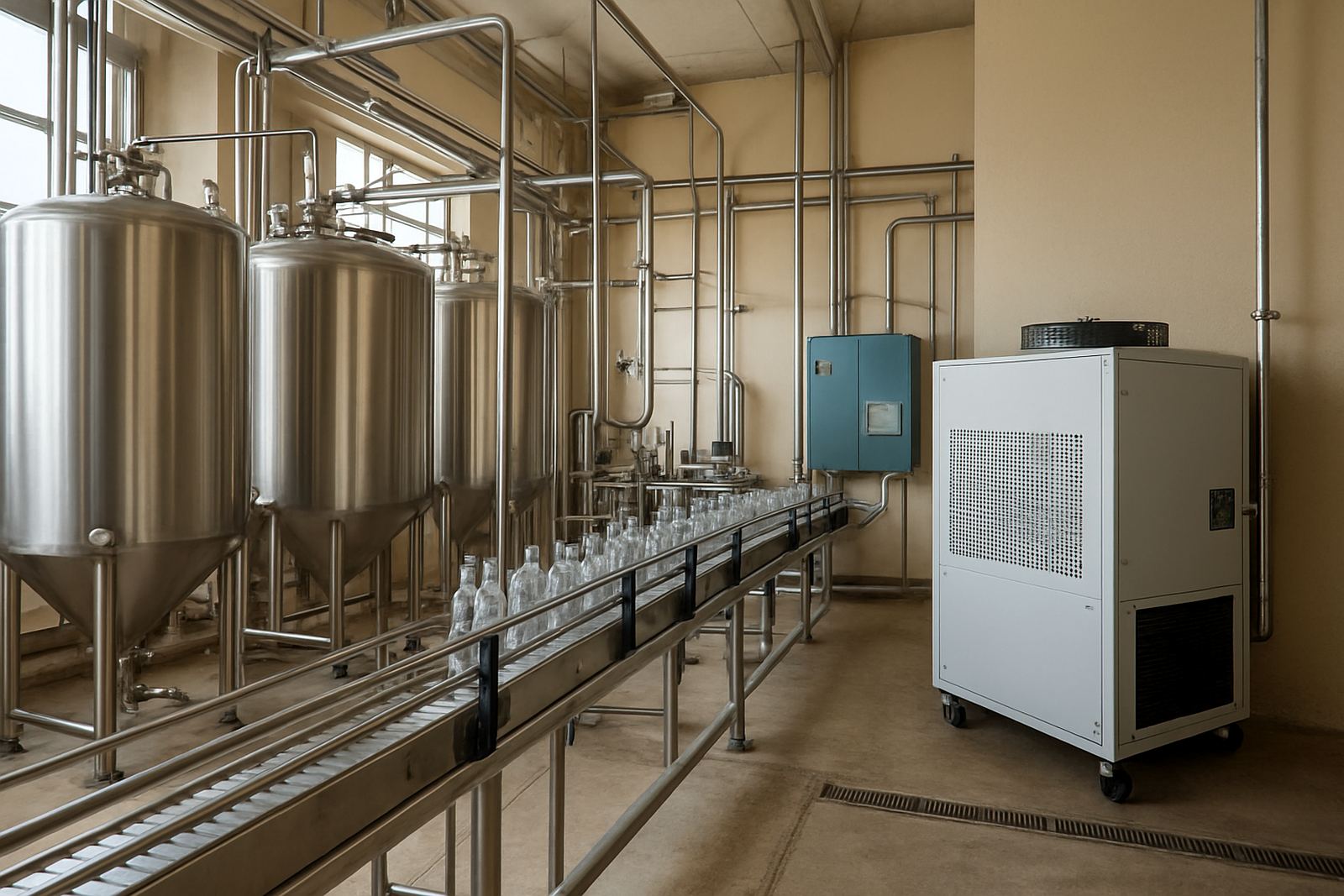
Typical beverage cooling equipment on site
A beverage line can use several cooling points rather than one single chiller serving everything. The exact set depends on the plant layout and product range, but the usual arrangement includes chilled water supply, insulated return lines, circulation pumps, a buffer tank and controls that keep the water temperature within the target band. In some plants, there is a dedicated loop for the filler area and another for process tanks or syrup rooms.
- Industrial water chiller sized for process duty
- Insulated buffer tank to reduce short cycling
- Duty and standby pumps where uptime is critical
- Strainers and water treatment checks to reduce fouling
- Temperature sensors, flow switches and control panel integration
- Pipework to mixers, jacketed vessels, heat exchangers or filling equipment
Where beverage lines are exposed to dusty warehouse conditions or coastal humidity, the control cabinet and electrical room need proper protection. On some sites in Durban and Cape Town, corrosion resistance and airflow around the condenser become as important as cooling capacity. If a plant is in a shared industrial area with limited floor space, the chiller room and pipe route should be planned early, not after the equipment arrives.
Layout and planning advice for a working production floor
The best cooling layout is the one that allows easy access for operators and service staff. Before installation, it helps to map the line from water source to load point, then check the distance, height changes and any points where pressure drop can become a problem. A chiller placed too far from the process may still work, but the system can lose efficiency and become harder to balance. If the plant expands later, the chilled water header should allow for another tank or filler without major rework.
Good planning also considers hygiene and cleaning. Beverage areas often have washdown routines, so pipe supports, valve positions and insulation finishes need to suit the environment. We usually advise plant managers to keep service clearances around the unit, leave space for lifting panels and make sure floor drainage is adequate around pump skids. It sounds basic, but many breakdowns start with poor access and rushed installations.
- Keep the chiller close enough to reduce pipe losses, but away from forklift damage
- Allow for future line growth, especially if another filler or tank will be added
- Separate clean process areas from general workshop traffic where possible
- Check ventilation paths so hot discharge air is not recirculated
- Use insulated pipework on exposed runs to prevent sweating and heat gain
Common mistakes that push running costs up
One of the most common mistakes is undersizing the cooling plant for peak demand. A line may appear to run fine during light production, then struggle once multiple tanks or jackets come online at the same time. Another issue is assuming the same chiller can handle every product changeover without checking the actual heat load. If the machine is working flat out all day, it will use more power and often wear faster than expected.
We also see poor water quality cause trouble. Scale, dirt and untreated make-up water can reduce heat transfer and block strainers or small passages in equipment. On some sites the problem is not the chiller at all, but weak flow caused by the wrong pump size or badly routed pipework. In a beverage plant, a small drop in flow can create bigger headaches at the filler and heat exchanger, so the whole circuit should be checked as one system, not in isolation.
Another mistake is ignoring backup during power interruptions. Many South African sites have to work around load-shedding or unstable supply, and beverage product can be sensitive to temperature drift during restart. A temporary cooling plan or staged restart sequence can save a lot of product loss and prevent the plant from overloading when power returns.
Budget ranges for beverage line cooling in Rand
Budgets vary according to cooling duty, the number of process points, pipe run length and whether the installation includes controls upgrades or temporary cooling. For smaller beverage support applications, a basic industrial water chiller package can start from about R180,000 to R350,000. Mid-sized production line systems with buffer tanks, pumps and integration commonly fall in the R350,000 to R850,000 range.
Larger or more complex beverage plants, especially where multiple jackets, mixers and filling support points are involved, can run from R850,000 to well over R1,500,000 depending on specification. That figure can move higher if the project needs pipework retrofits, refrigeration repairs, control panel upgrades or staged installation during live production. It is worth pricing the full cooling system, not just the chiller skid, because omitted items often come back later as downtime costs.
For plants that need a short-term bridge while permanent equipment is serviced or upgraded, temporary cooling can be a practical option. It is often cheaper than losing product or stopping a line, and it gives the team time to plan the permanent solution properly.
How Raynen supports beverage plants across South Africa
Raynen works from Alrode, Alberton, with service coverage for Johannesburg, Pretoria, Durban, Cape Town, Rustenburg and surrounding industrial areas. Our team assists beverage clients with chiller installation, commissioning, preventative maintenance, breakdown repairs, pump replacements, water treatment checks, pipework retrofits, control panel upgrades, cooling audits, temporary cooling and operator training. For plants that cannot afford long stoppages, we aim to plan work around production windows and keep the installation clean and predictable.
The technical sales and service team, including Riaan van der Merwe and our site staff, focus on practical solutions that fit the line, the building and the budget. That may mean a compact chiller for a single process loop, or a larger arrangement with better control and standby capacity. We also help clients assess whether the current system is still viable or whether repairs are becoming more expensive than a replacement. In many cases, a clear cooling audit will show the fastest path to better uptime.
- New beverage line installations and system commissioning
- Upgrades to ageing cooling loops and controls
- Routine maintenance to reduce breakdown risk
- Support for production plants in inland and coastal conditions