

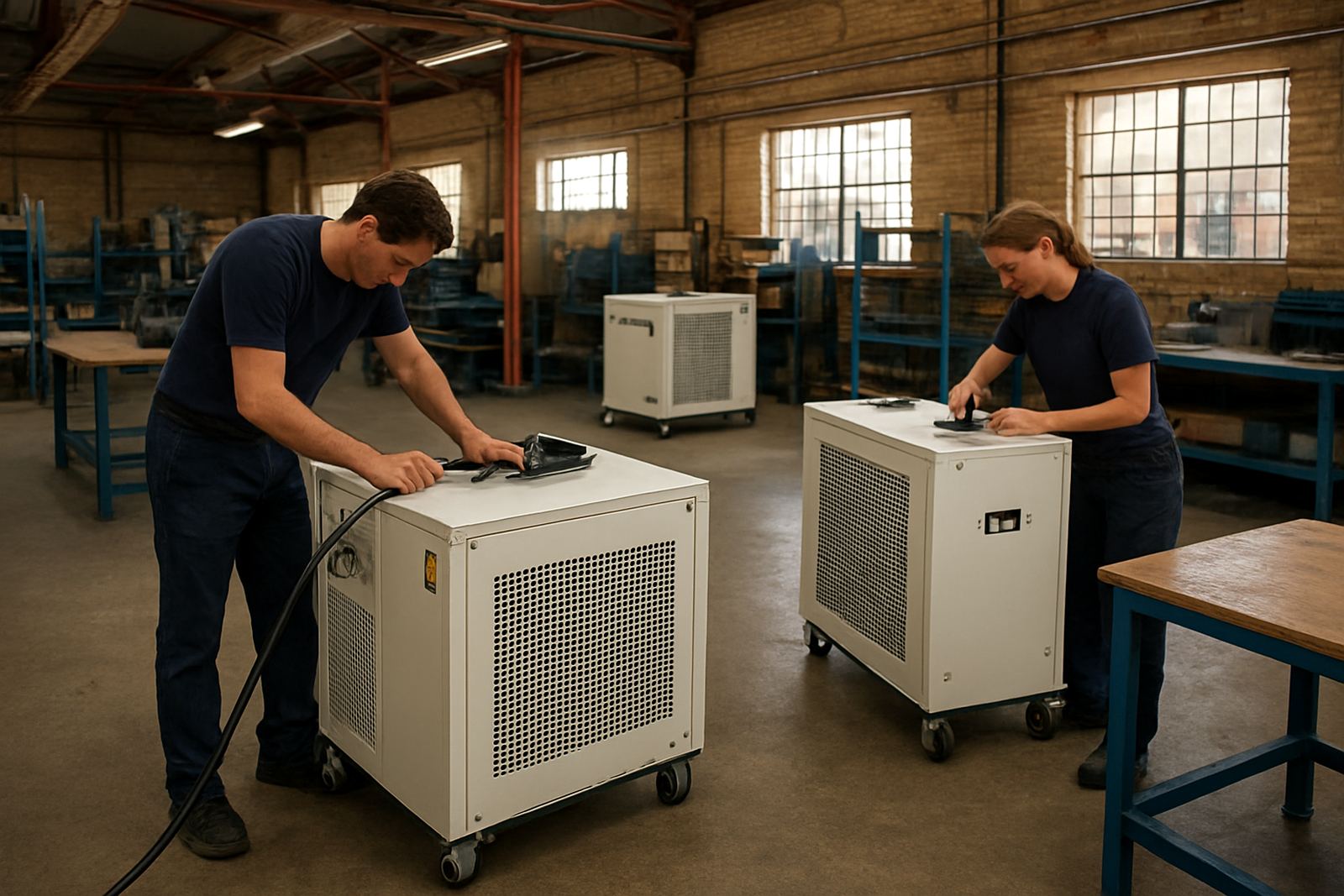
2008: A small start in Alrode with a practical brief
Raynen began in 2008 in Alrode, Alberton, serving local manufacturers who needed stable cooling for lasers, moulds and process lines. The first projects were driven by a simple problem seen again and again: machines were being pushed hard, but cooling was inconsistent, and that led to poor product quality, unplanned stoppages and extra wear on equipment.
From the start, the approach was hands-on. Every site needed a proper assessment, not a guess. Water quality, ambient heat, dust levels, load-shedding risk and pipe runs were all taken into account before any unit was selected or installed. That early discipline shaped the way the company still works today.
- Started in Alberton with a focus on industrial cooling for production environments
- Built early experience around laser cooling, mould cooling and process line temperature control
- Established a service-first culture from day one
2010 to 2013: Building trust through better installs and faster support
As word spread through Ekurhuleni and the greater Johannesburg area, the work grew beyond single installations. Customers wanted more than equipment supply, they wanted help with commissioning, pump sizing, pipework layout and ongoing maintenance. Raynen responded by putting stronger systems in place for installation and support, so each chiller could be matched properly to the job.
These were years of building trust one site at a time. Plants running through summer heat, workshops dealing with dust and vibration, and coastal clients dealing with humidity all needed different solutions. The team learned to account for local conditions instead of treating every site the same, which made the difference between a short-term fix and a long-term solution.
- Expanded service support across Johannesburg and nearby industrial zones
- Added structured system commissioning and preventative maintenance work
- Improved response times for breakdown repairs and urgent cooling faults
2014 to 2016: Wider industry use and more specialised applications
By the middle years, Raynen was working across a broader mix of industries. Laser users needed tighter temperature control to protect accuracy. Moulding operations needed consistent cooling to keep cycle times steady. Process lines needed dependable temperature control to maintain product quality and reduce waste. The company also started handling refrigeration repairs, water treatment checks and temporary cooling for planned shutdowns and emergency situations.
This period also brought more technical work on ageing systems. Some sites had undersized units, some had poor water treatment, and some had control panels that had been patched over too many times. Raynen’s team focused on practical upgrades that improved the life of existing equipment, rather than forcing clients into unnecessary replacement. That was good for budgets and better for uptime.
- Supported more varied production sites, from light manufacturing to heavy industrial use
- Introduced control panel upgrades and pipework retrofits for older systems
- Helped clients manage seasonal heat and load-shedding pressure with temporary cooling plans
2017 to 2019: A stronger service footprint across Gauteng and beyond
As more businesses needed reliable support outside the main metro areas, Raynen extended service coverage into Pretoria, Germiston, Boksburg and Rustenburg. The same period also saw more work in Durban and Cape Town, where climate and site conditions demanded different maintenance routines. A cooling unit that performs well inland may need extra care at the coast, especially where corrosion and moisture are part of everyday operations.
To support that growth, the company developed clearer roles and better scheduling. Site visits, workshop repairs and spare parts planning had to be coordinated properly so clients were not left waiting. The team also started formalising operator training, because many cooling problems can be prevented with simple day-to-day checks and better understanding at the plant level.
- Extended service coverage to Pretoria, Durban, Cape Town and Rustenburg
- Formalised operator training to reduce avoidable downtime
- Improved workshop coordination for faster turnaround on repairs
2020 to 2022: Keeping industry running through tougher conditions
These years tested many South African businesses, and cooling systems became even more important. Production teams had to do more with less, while keeping temperature-sensitive equipment stable through power interruptions and changing demand. Raynen focused on practical support such as temporary cooling, preventative maintenance and urgent breakdown repairs to help clients keep operating when conditions were difficult.
The company also sharpened its approach to water treatment checks and system monitoring. When water quality is ignored, scale build-up and corrosion can cause problems quickly, especially where systems run long hours. By paying attention to the basics, Raynen helped clients protect pumps, heat exchange surfaces and pipework, and that saved money over the long run.
- Supported critical production sites during power interruptions and shutdown periods
- Increased attention to water treatment and reliability checks
- Kept repair response focused on practical recovery, not just patch jobs
2023 to today: A broader team, the same practical standard
Today, Raynen operates from Alrode, Alberton with a broader team and a wider service footprint, but the core idea has not changed. The company still builds every job around the same priorities: correct sizing, careful commissioning, proper maintenance and honest support when something fails. That is why clients continue to come back for chillers, cooling units, pumps, control work and service planning.
The team now includes Riaan van der Merwe as Managing Director, supported by Lerato Mokoena, Sibusiso Dlamini, Anika Naidoo, Pieter Joubert, Nomsa Khumalo and Thabo Maseko. Each person plays a part in keeping projects organised, workshops moving and clients informed. It is a practical setup, not a flashy one and that suits the work perfectly.
- Alberton Depot with service reach through Johannesburg, Pretoria, Durban, Cape Town and Rustenburg
- Ongoing support for chiller installation, commissioning, maintenance and repairs
- Focused on reliable cooling for lasers, moulds and process lines across South Africa
From the first year of trading to today, Raynen has grown by staying close to the realities of industry. The work is still about steady temperatures, fewer stoppages and equipment that lasts longer. In a country where factories must cope with heat, power interruptions and tough operating conditions, that kind of consistency matters.