Why laser cutting cooling cannot be left to chance
Laser cutting machines work best when the chiller holds temperature steady through a full shift, not just at start-up. In workshops around Alberton, Johannesburg, Pretoria and Durban, heat build-up, dust and load-shedding can all push the cooling system harder than expected. A stable chiller helps reduce thermal stress on the laser source and keeps the machine cutting consistently, especially on longer runs.
For fibre and CO2 systems, the cooling demand is different, but the aim stays the same: keep the process water within a controlled range and stop short cycling. If the water runs too warm, the machine may slow down, alarms may trip and the cut edge can suffer. If it runs too cold, condensation can form in humid areas near the coast, which is not something you want around sensitive components.
Typical laser cutting setup and what the chiller supports
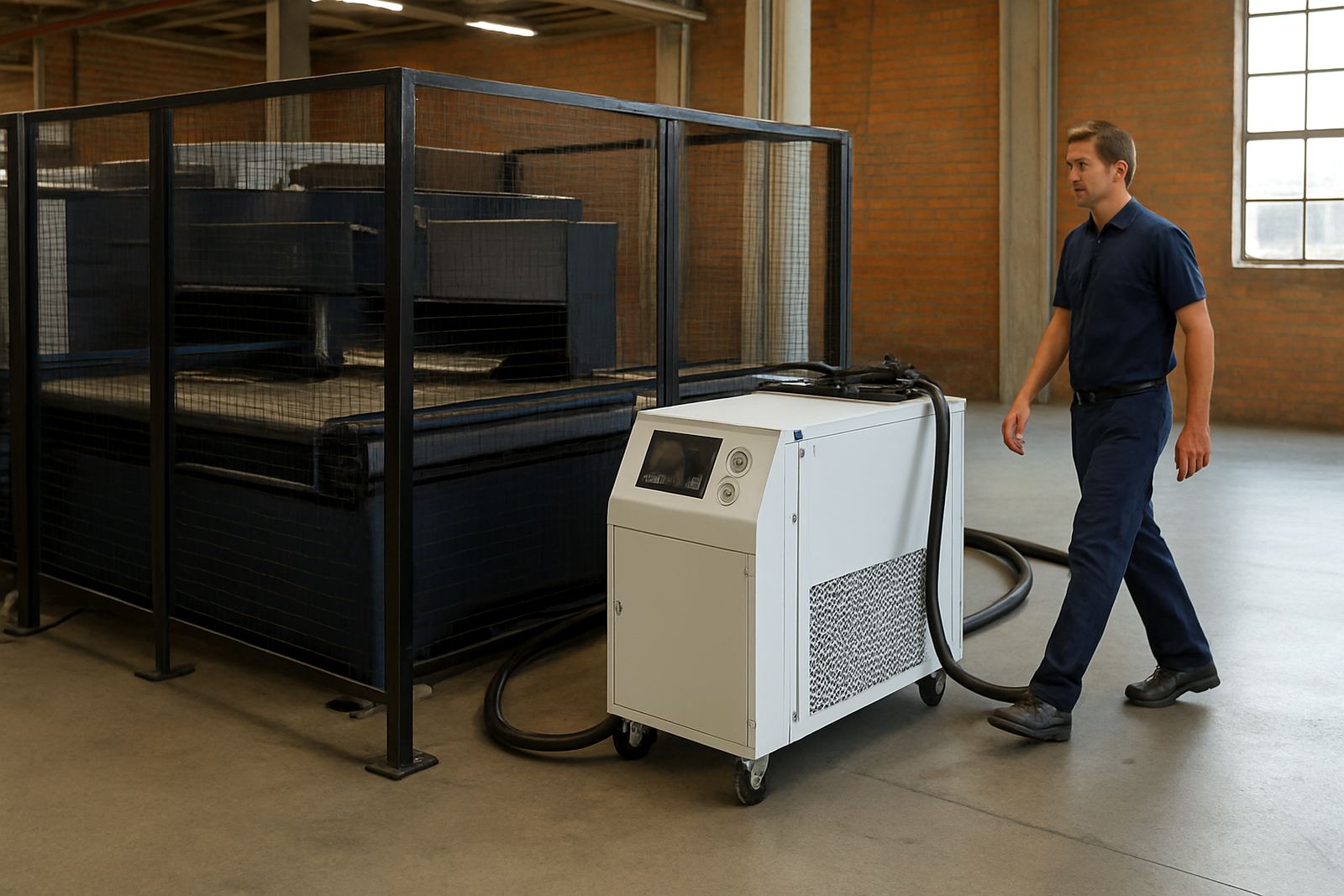
A laser cutting line normally includes the laser source, cutting head, control cabinet, coolant circuit, pipework, filtration and sometimes a secondary process line tied into the same utility area. The chiller may serve just one machine or feed several units where production is tightly packed. In busy plants, the cooling equipment often sits in a service corridor, outside the cutting bay, or on a plinth with enough space for airflow and maintenance access.
Common equipment that needs proper cooling support includes:
- Laser source cooling circuits
- Cutting head or optical cooling loops
- Water-cooled process lines
- Pump sets and recirculation circuits
- Remote condensers or heat rejection units
- Inline strainers and treatment systems
Raynen works with industrial water chillers and cooling units sized for the actual duty, not a rough guess. That matters when the machine runs long hours, the ambient temperature climbs in summer, or the plant has voltage dips and generator changeovers that affect overall performance.
Planning the layout before installation starts
Good layout planning saves trouble later. Before installation, the team needs to check the machine type, heat load, pipe lengths, elevation changes, water quality and where the unit will sit in the building. In factory environments across Ekurhuleni and the wider Gauteng area, poor placement can lead to long pipe runs, unnecessary pressure loss, and maintenance problems when access is tight.
As a rule, leave enough clearance for airflow around the chiller, easy access to filters and valves, and a clear route for service work. If the unit is outdoors, consider sun exposure, rain, dust and security. On coastal sites in Durban and Cape Town, corrosion protection and humidity control become more important. If a backup generator is used, the cooling system must be checked for restart behaviour after outages, because some lines struggle to recover if the water circuit is unstable.
- Keep the chiller close enough to limit pressure drop, but not cramped against a wall
- Allow for isolation valves so maintenance can happen without shutting the whole line
- Use correctly sized pipework to avoid flow restriction
- Plan for drain points and water treatment access
- Check how the system behaves during load-shedding and restart
Common mistakes that shorten machine life
One of the biggest mistakes is choosing a unit by machine size alone, without looking at the actual duty cycle. A laser cutter that runs plate after plate all day needs a different cooling approach from one used for short production batches. Another issue is poor water management. Untreated water can carry scale, sludge and corrosion into the circuit, which blocks flow and increases wear on pumps and heat exchangers.
It is also common to see pipework installed with unnecessary bends, undersized hose, or poor insulation. That can cause pressure loss and temperature swings. In some workshops, the chiller is placed where it recirculates hot air, especially in enclosed service rooms. The unit then works harder than it should, and the operator assumes the machine is at fault. In reality, the cooling system was set up badly from the start.
Another avoidable issue is skipping operator training. A simple daily check on temperature, flow and warning lights can catch small faults before they become breakdowns. That kind of routine is worth it when a single interrupted shift can affect a full production order.
Budget ranges for laser cutting cooling in Rand
Budget depends on cooling capacity, duty cycle, controls, pipework, and whether the installation is new or a retrofit. As a broad guide, smaller single-machine cooling packages may start from about R85 000 to R160 000, while medium industrial systems can range from R160 000 to R350 000. Larger or multi-machine setups, especially where controls, pumps, treatment and commissioning are included, can move into the R350 000 to R750 000 plus range.
It is worth separating the purchase price from the full installed cost. Installation, commissioning, pipework retrofits, control panel upgrades, and water treatment checks can all change the final figure. If the plant needs temporary cooling during a shutdown or upgrade, that should also be budgeted for. A slightly higher upfront spend can save money over time by reducing breakdowns, protecting the laser source and cutting unplanned maintenance.
For businesses in Johannesburg, Pretoria, Rustenburg, Cape Town and Durban, the right budget should also include service access. If the system is difficult to reach or maintain, the long-term cost usually climbs. A practical quote should show what is included and what is not, so there are no surprises later.
How Raynen supports laser cutting users across South Africa
Raynen supplies and services industrial water chillers and cooling units from its base in Alrode, Alberton, with support for sites in Johannesburg, Pretoria, Germiston, Boksburg, Durban, Cape Town and Rustenburg. The work starts with understanding the machine, the plant conditions and the temperature stability the process needs. From there, the team can recommend chiller installation, system commissioning, preventative maintenance, breakdown repairs, pump replacements, control panel upgrades and cooling audits.
The service team also handles temporary cooling, which is useful when production cannot stop during a repair or upgrade. For laser cutting operations, that can make the difference between staying on schedule and losing a full day. The practical aim is simple: keep the water circuit steady, protect the equipment, and reduce the chance of unexpected stoppages.
When a customer sends through an enquiry form, Raynen can assess the application and advise on the next step. Whether the job is a single laser cutter or a full production line, the approach stays grounded in actual site conditions, not guesswork.