Why temperature control matters on blow moulding lines
In blow moulding, small temperature swings show up fast. A bottle wall can go thin on one cycle, then stay too hot on the next, which affects shape, clarity and pinch-off quality. On busy plants around Alberton, Germiston, Boksburg and Johannesburg, that means more scrap and more pressure on operators trying to keep the line moving.
A properly sized chiller helps keep moulds, hydraulic oil interfaces and cooling circuits at a steady setpoint. That consistency matters whether you are making PET bottles, detergent containers or industrial packaging. It also helps reduce stress on tooling, which is important when moulds are costly and downtime is not something you can easily make up later in the shift.
We see many plants chasing a cooling problem at the machine when the real issue is elsewhere in the loop. Restricted strainers, undersized pipework, poor water quality or badly balanced return headers can all create uneven cooling. A site review should look at the full route, from chiller to mould and back again.
Typical cooling set-up for bottles and containers
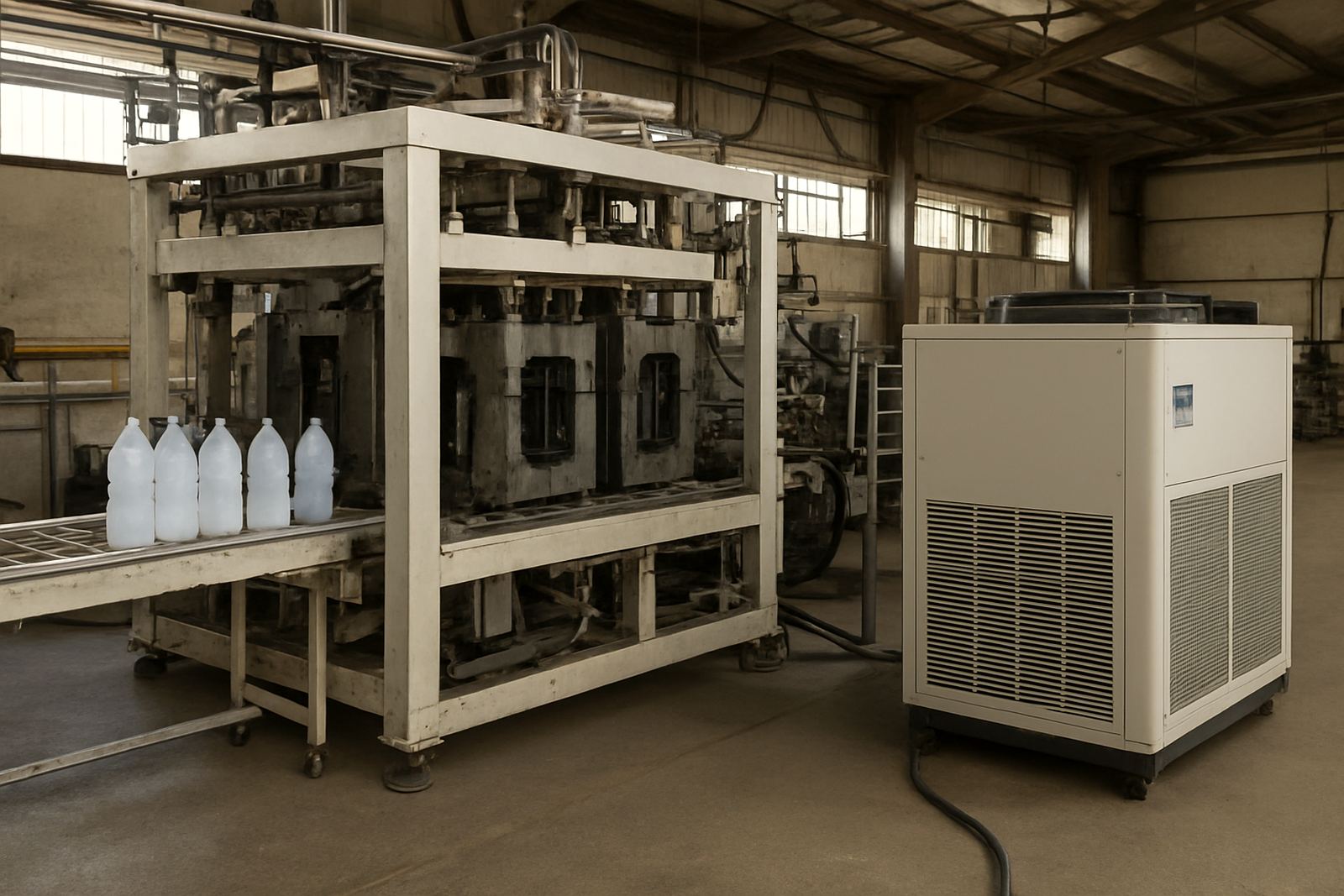
Most blow moulding facilities use a combination of process chillers, a water circulation network and local control valves at the machine. Depending on the line, the chilled water may serve moulds, neck rings, cooling plates, trim stations and sometimes auxiliary equipment such as compressors or hydraulic coolers. In larger plants there may also be a buffer tank to stabilise flow during rapid changes in demand.
Common equipment we find on these lines includes:
- Industrial water chiller sized to the line load
- Insulated buffer tank for temperature stability
- Circulation pump set with duty and standby options
- Filtration and water treatment points
- Flow switches, gauges and temperature controls
- Piping manifolds to balance multiple machines
For coastal sites in Durban or Cape Town, water treatment becomes even more important because humidity and corrosion can shorten component life. Inland plants around Pretoria or Rustenburg may deal more with dust and scale, especially where top-up water quality is poor. Either way, a simple filter bag and a once-off flush is seldom enough.
Planning the layout before you buy a chiller
Good planning starts with the line map, not the machine brochure. You need to know the number of cavities, cycle times, mould temperature requirements, ambient conditions and whether the system must support one machine or several. A plant in Alrode with three blow moulders will not have the same cooling profile as a single high-speed line in Cape Town.
When we review a site, we normally check the following:
- Total cooling load in kW or kCal/h
- Required supply and return water temperatures
- Distance from chiller to machine and pressure loss
- Available floor space and ventilation
- Electrical supply and load-shedding backup needs
- Whether temporary cooling is needed during changeovers or repairs
It is worth leaving space for maintenance access as well. A unit squeezed between a wall and a pipe rack is harder to service, and that often leads to delayed repairs. Simple things like a clear filter access panel or enough headroom above the tank can save time later. One small layout mistake can cause repeated stoppages, and those are expensive on a 24 hour line.
Common mistakes that lead to scrap and stoppages
Blow moulding plants often run into the same problems again and again. One of the biggest is undersizing the chiller because the machine ran acceptably in winter. Once summer arrives, water temperatures rise and the mould can no longer hold the same cycle quality. Another common mistake is running long pipe runs without proper insulation, so the line loses cooling before it reaches the mould.
Other issues we see include poor pump selection, blocked strainers, neglected condenser cleaning and control settings that are left on manual for weeks at a time. If the operator team keeps adjusting the setpoint just to get through a shift, the actual problem is usually upstream. A cooling audit can help identify whether the fault is in the chiller, the pipework or the machine itself.
Typical mistakes include:
- Choosing a unit only by machine tonnage, not actual heat load
- Ignoring warm ambient conditions in summer
- Mixing treated and untreated water in the same loop
- Skipping preventative maintenance until a breakdown happens
- Using temporary hoses that are too small for the flow needed
Budget ranges for blow moulding cooling in Rand
Budget depends on line size, number of moulds, required redundancy and whether you are replacing a failed unit or planning a new install. For a small to medium blow moulding line, a practical project can start from about R180 000 to R450 000 for a suitable industrial chiller and basic integration. Bigger or multi-line set-ups, especially where you need buffer tanks, upgraded controls or standby capacity, can run from R500 000 to R1.2 million and beyond.
That range usually covers the main cooling package, but not every site is ready for a straight swap. Pipework retrofits, electrical work, control panel upgrades and pump replacements can add to the total. If a plant needs temporary cooling during a shutdown, that should also be costed in, because a lost day of production often costs more than the equipment hire itself.
For maintenance planning, many plants set aside an annual service budget of 5% to 10% of the cooling system value. That helps cover refrigerant checks, water treatment, labour and consumables before a major failure interrupts production.
How Raynen supports blow moulding operations nationwide
Raynen is based in Alrode, Alberton and supports customers across South Africa, including Johannesburg, Pretoria, Durban, Cape Town and Rustenburg. Our team includes people who handle operations, technical sales, workshop work and field service, so we can support the project from the first enquiry through to commissioning and ongoing maintenance.
We assist with chiller installation, system commissioning, preventative maintenance, breakdown repairs, refrigeration repairs, pump replacements, water treatment checks, pipework retrofits, control panel upgrades, cooling audits, temporary cooling and operator training. That makes it easier to keep a bottle or container line running even when a component fails or the plant needs a planned shutdown. Clients usually come through the enquiry form on our contact page, and we then assess the application, the site layout and the required cooling duty.
For blow moulding, the goal is simple: steady temperatures, fewer rejects and a line that keeps its pace. If the cooling side is right, the rest of the process is easier to manage.