When a buffer tank earns its place
A buffer tank becomes useful when your cooling circuit changes faster than the chiller can respond. That happens on laser systems with intermittent cutting, injection moulding lines that open and close in cycles, and process equipment that starts and stops through the day. If the flow rate keeps jumping, the chilled water temperature can swing too much and the machine never sees steady conditions.
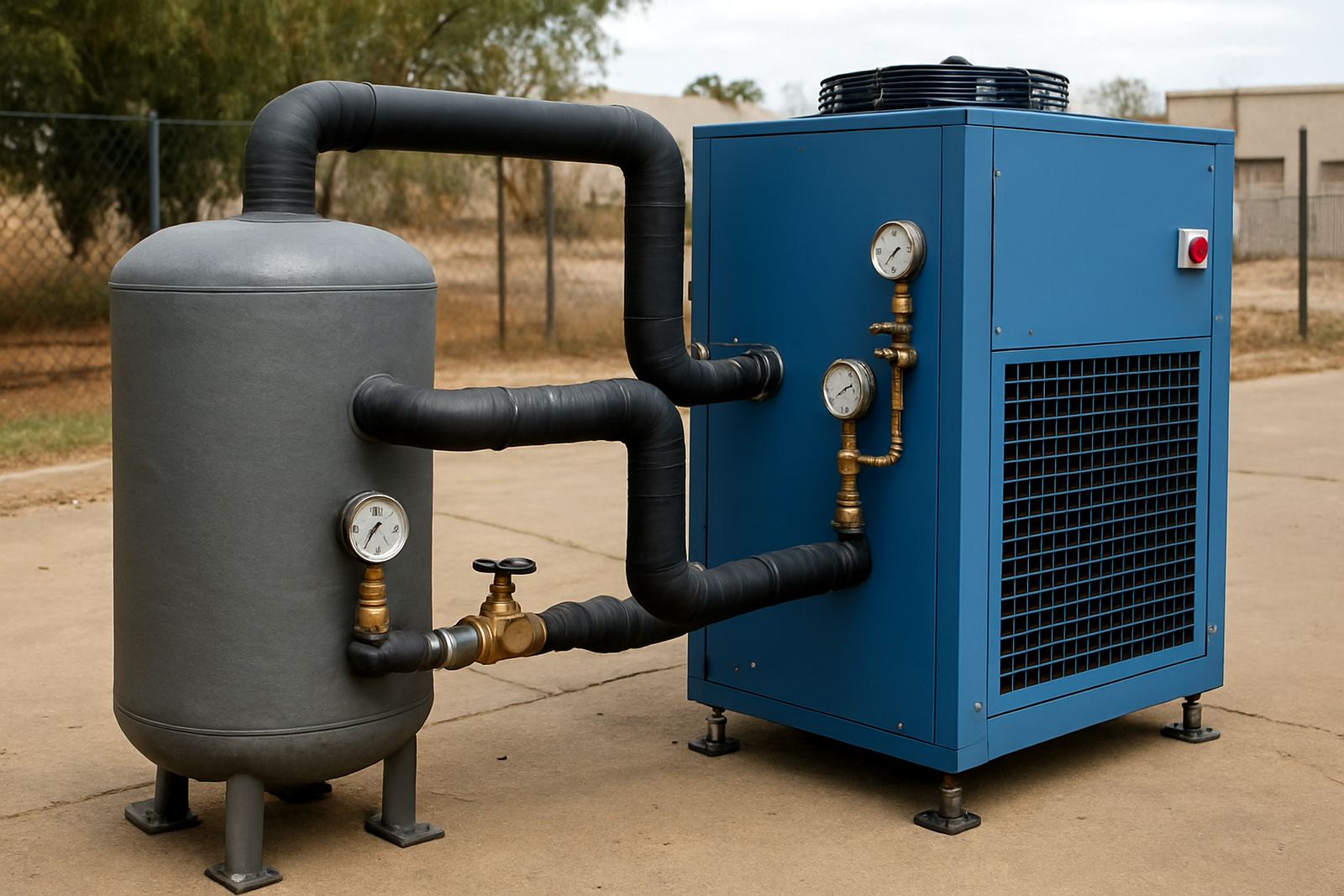
The first question is simple: do you have enough system volume for the chiller to work calmly? Small pipe runs, compact skids and modern equipment can leave a system with very little water in circulation. In that case the chiller may short cycle, especially during mild weather or overnight when the load drops. A buffer tank gives the system more thermal mass, so temperature changes slower and the equipment has time to settle.
- Use it where the process load is not constant.
- Use it where the water volume is too low for stable operation.
- Use it where frequent compressor starts are causing wear.
- Use it where temperature drift is affecting product quality or machine alarms.
Sizing starts with the real duty pattern
Do not size a buffer tank from guesswork. The correct size depends on the chiller capacity, the minimum run time you want, the allowable temperature swing, and how quickly the process load changes. A tank that is too small gives very little benefit. A tank that is too large can waste floor space and make commissioning harder without solving the real issue.
A practical approach is to look at the worst case: peak load, lowest load and the transition between the two. On a laser line, for example, the machine may idle for minutes and then pull a sharp cooling load when production starts again. On mould cooling, the load can rise in bursts as cycles speed up. The buffer tank should smooth those swings enough that the chiller does not chase every change.
As a rough rule, the more unstable the load, the more helpful the tank becomes. But the final selection should also consider pump head, pipework resistance, glycol use if applicable, and whether the system is indoors or exposed to heat. In Durban coastal humidity, corrosion resistance and insulation matter more than many buyers expect.
What a buffer tank does for lasers and moulds
For laser cooling, stable water temperature helps protect optics, maintain beam consistency and reduce nuisance trips. If the chiller is constantly hunting, the laser can see temperature fluctuations that affect performance. A buffer tank helps keep the return temperature more even, especially where the laser is used in short shifts or mixed production runs.
For mould cooling, temperature stability affects cycle time and part quality. If the mould water supply rises and falls too quickly, surface finish and dimensional control can suffer. That is one reason mould shops often notice a difference after adding a properly sized tank and balancing the loop correctly. The improvement is not dramatic for show, but it shows up in less rework and more repeatable output.
- Smoother supply temperature to the machine.
- Less compressor cycling and less start-up wear.
- Better response to sudden changes in demand.
- Reduced nuisance alarms on sensitive equipment.
Installation details that are easy to get wrong
The tank itself is only part of the job. Location, pipe connections and controls all affect whether it works as intended. A tank should be installed where it can be serviced, insulated properly and connected with short, sensible pipe runs. If the tank is badly placed, it can add unnecessary pressure drop or make venting and draining awkward during maintenance.
Pay attention to the pump arrangement too. Some systems need constant circulation through the tank, while others need it as a decoupler between the chiller and process side. The wrong arrangement can cause stratification, poor temperature sensing or unnecessary mixing. That is why commissioning matters as much as the hardware.
On South African sites, power interruptions also need to be considered. After a load-shedding event, a system may restart with warm water in the loop and a sudden load from machines coming back online. A buffer tank helps absorb that restart shock, but only if the controls and pump sequence are set correctly.
A local example from Alberton to Rustenburg
We often see this issue on sites around Alberton and Germiston where compact plant rooms were built to save space. One example involved a process line supplying a laser cell and a small moulding section from a chiller that had enough capacity on paper, but not enough system volume in practice. Every time production changed, the water temperature jumped and the chiller kept cycling.
After reviewing the layout, the team added a buffer tank, adjusted the pump arrangement and checked the control settings. The result was steadier return water, fewer alarms and less wear on the refrigeration side. The same principle applies in hotter inland areas like Rustenburg where ambient temperatures and dusty conditions can make unstable cooling systems more difficult to run all day.
The lesson is simple: a buffer tank is not there to hide a bad system, it is there to support a system that needs more thermal stability than the existing pipework can provide.
Choosing the right support setup for your site
Before you commit, compare the tank option against the full site requirement. In some cases you may need a buffer tank plus pipework retrofits, a control panel upgrade or pump replacement to get the result you want. If the water quality is poor, a tank alone will not stop scaling, corrosion or blocked strainers. If the process water is carrying debris, water treatment checks should form part of the decision too.
Use this checklist before ordering:
- Measure the current system volume and flow pattern.
- Check how often the chiller starts and stops in a normal shift.
- Confirm the temperature range the process can tolerate.
- Inspect insulation, pipe length and return line layout.
- Allow space for maintenance access and drain points.
- Review restart behaviour after power cuts or plant downtime.
For many South African plants, the best answer is not a larger chiller, but a better balanced system. A buffer tank can be a practical way to get there when the process is fast moving and the cooling circuit is undersized in volume.